



Technical Resources
OpenSAMPL 1.2.0 Launch
OpenSAMPL 1.2.0 is a timing-observability release for Network Time Protocol (NTP)
and Software Development Kit (SDK) improvement for ease-of-use in adding additional timing probes.
The release formalizes NTP collection from both local and remote sources while improving the SDK to
scaffold workflows that generate new probe types. Finally, the release hardens Grafana dashboards and
consolidates backend API and migration code, as well as strengthens tests to reduce regression and
deployment friction.
August 21, 2026
TWSTFT Network Testing
This technical bulletin on Two Way Satellite Time and Frequency Transfer (TWSTFT)
explores the possibility of using this technology as an augmentation and/or replacement for traditional
GPS time synchronization. While very useful, GPS (and other GNSS) suffer from problems such as jamming,
spoofing, and malfunctioning equipment. This technical bulletin demonstrates the limits and quantifies
the performance of a geographically disparate TWSTFT network using commercial off the shelf (COTS)
hardware.
August 14, 2026
GPS Signal Monitoring Report
This report explains how GPS signals can be disrupted or spoofed, and why that
matters for everyday services that depend on accurate timing and location, such as power systems,
communications, transportation, and finance. It describes tests carried out by Oak Ridge National
Laboratory’s Center for Alternative Synchronization and Timing (CAST) to see how well commercial
equipment can handle these threats. The results show that many devices have difficulty recognizing
interference, especially spoofing, which can quietly mislead a system without obvious warning. The
report also highlights the need for stronger protections, better monitoring, and backup timing options
that do not rely only on GPS.
August 14, 2026
Introducing OpenSAMPL: A Platform for Time Assurance Monitoring
The Open Synchronization Analytics and Monitoring Platform (OpenSAMPL) is an
innovative toolkit that provides a comprehensive, open-source solution for clock data ingestion,
management, and visualization. Using PostgreSQL with the TimescaleDB extension and Grafana, OpenSAMPL
enables users to monitor timing and synchronization across critical systems such as power grids,
telecommunications networks, and research laboratories. OpenSAMPL is purpose-built to enhance the
reliability of time-critical systems by offering seamless integration with industry-standard clock
sources such as Adtran probes and Microchip Trust Web Service Token files. By embracing open-source
collaboration, OpenSAMPL eliminates reliance on proprietary systems or multiple fragmented dashboards
while empowering researchers and organizations to optimize their infrastructure.
February 10, 2026
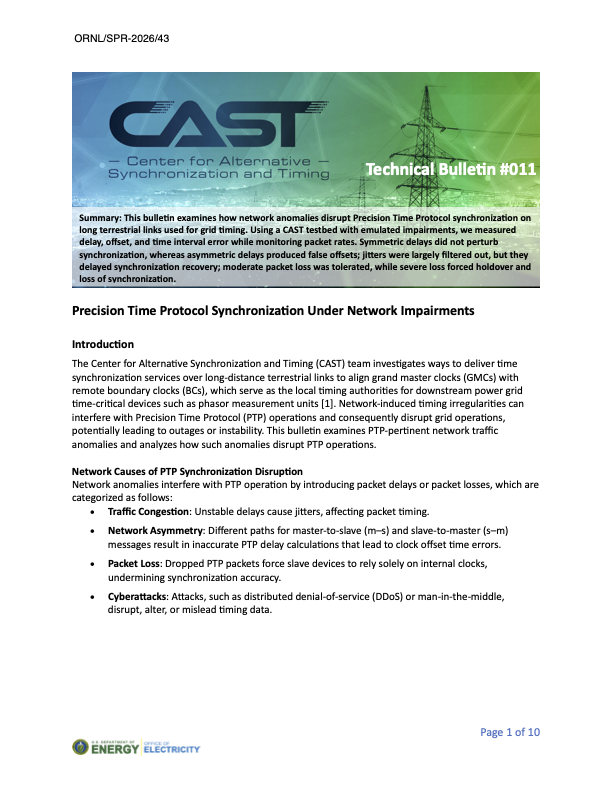
Precision Time Protocol Synchronization Under Network Impairments
This bulletin examines how network anomalies—such as symmetric/asymmetric delays,
jitter, and packet loss—affect Precision Time Protocol (PTP) synchronization used in power grid timing.
Testbed experiments reveal that while symmetric delays have little impact, asymmetric delays and
severe jitter or packet loss can lead to significant offset errors and potential loss of synchronization,
highlighting the need for robust, proactive network designs and monitoring.
February 05, 2026
CAST PTP Network Monitoring Report
The report analyzes how various network anomalies directly impact Precision Time
Protocol (PTP) performance and synchronization accuracy. Using controlled tests, the report demonstrates
that such anomalies can lead to miscalculated delays and offsets, potentially disrupting time
synchronization in critical infrastructures like power grids, and emphasizes the need for robust,
PTP-aware network designs and proactive monitoring to mitigate these effects.
February 05, 2026

Timing and Synchronization for Modern Power Grids
Accurate and synchronized timing signals are necessary for effective monitoring,
control, coordination, and protection of power grids. This report explores the various services
prevalent in power grids, focusing on their critical timing requirements for effective operational
functionalities and performance. The importance of precise timing and synchronization across various
power grid services is examined, highlighting how timing and synchronization influences the
reliability and efficiency of power grids.
October 13, 2025
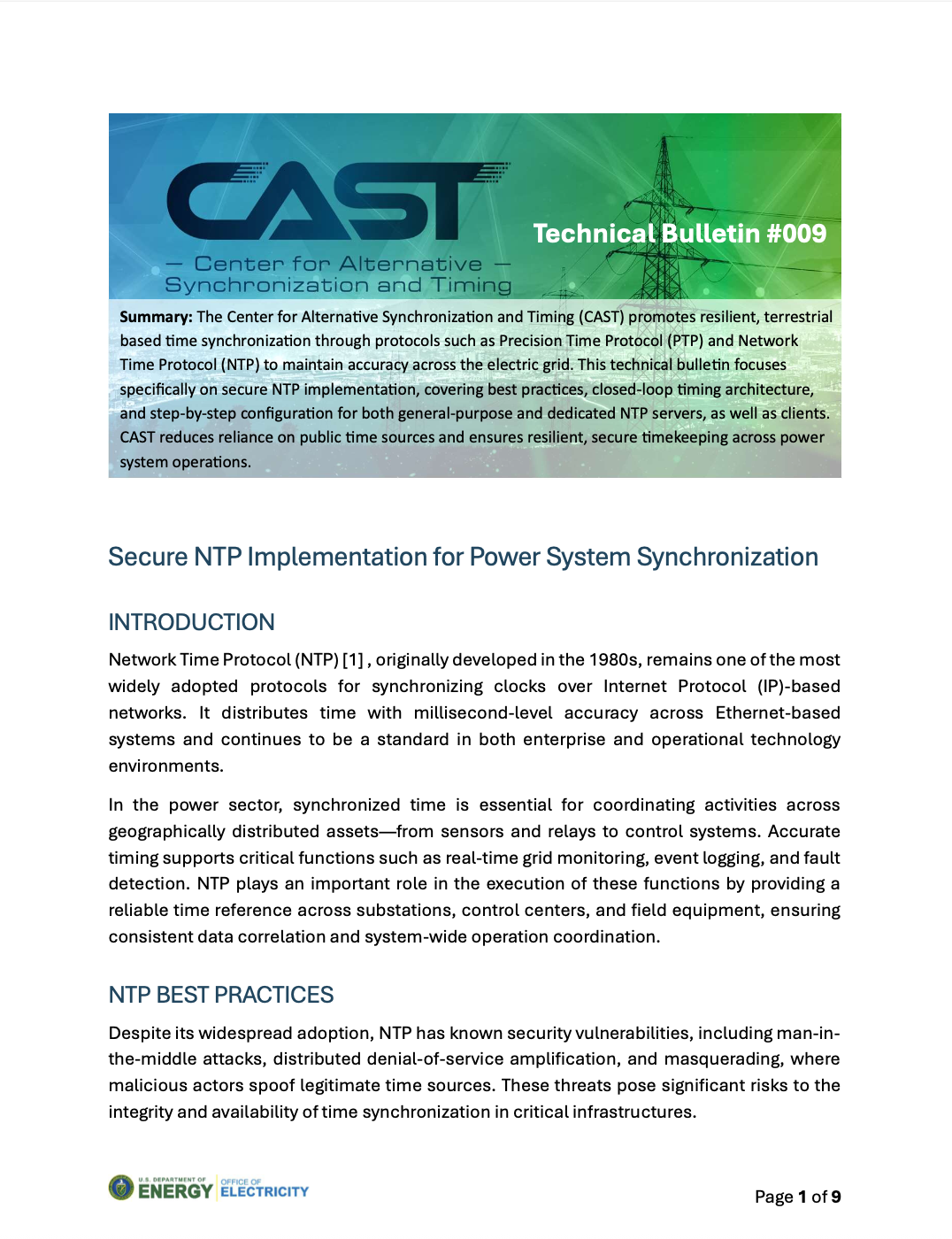
Secure NTP Implementation for Power System Synchronization
The Center for Alternative Synchronization and Timing (CAST) promotes resilient,
terrestrial based time synchronization through protocols such as Precision Time Protocols (PTP) and
Network Time Protocol (NTP) to maintain accuracy across the electric grid. This technical bulletin
focuses specifically on secure NTP implementation, covering best practices, closed-loop timing architecture,
and step-by-step configuration for both general purpose and dedicated NTP servers, as well as clients. CAST
reduces reliance on public time sources and ensures resilient, secure timekeeping across power system
operations.
August 12, 2025
Implementing a Terrestrial Timing Solution: Best Practices
This document is an overview and guide on the concept of precision time and how an
alternative terrestrial timing solution to the Global Positioning System (GPS) can be implemented. A set of
recommendations and best practices, derived from research at Oak Ridge National Laboratory, across industry,
and within the US government are provided to enable implementation of a system of precision timing and
synchronization to support resilient operations for the US grid. Precision time is a fundamental necessity
for operating the grid today, and it becomes even more important as the grid modernizes with distributed
energy resources, microgrids, and precision sensors placed throughout the grid system to ensure
failure-resistant operations. The Global Navigation Satellite System (GNSS), which includes GPS, is currently
the primary provider of precision timing. A terrestrial-based system for time delivery and synchronization to
augment GPS is outlined in this document. It provides secure time, synchronized with Coordinated Universal Time
(UTC), in the event of outages or other interruptions associated with time delivery.
July 23, 2025
Performance of Precision Time Protocol (PTP) over Optical Transport Networks (OTN)
The US Department of Energy Office of Electricity has partnered with Oak Ridge National
Laboratory (ORNL) to find alternative precision timing solutions for the nation's power grid. This effort is in
response to the vulnerabilities identified in the Global Navigation Satellite System (GNSS), of which the US Global
Positioning System (GPS) platform is a part. Additionally, Executive Order 139055 has highlighted the need for
alternative or backup timing solutions. ORNL has established a Timing Lab and has been testing various
technologies and timing devices as part of this effort. Precision Time Protocol (PTP), and the off-the-shelf
timing devices and network connections that support it, are among the alternatives being tested. This work reports
the accuracy of PTP over the Optical Transport Network (OTN) and is part of a series published by the Center for
Alternative Synchronization and Timing (CAST).
June 20, 2025

Lessons Learned from TWSTFT Implementations
Two-way satellite time and frequency transfer (TWSTFT) has been a trusted time
transfer and synchronization method for a long time. It provides good timing accuracy, usually 100 ns
or less.
May 16, 2025
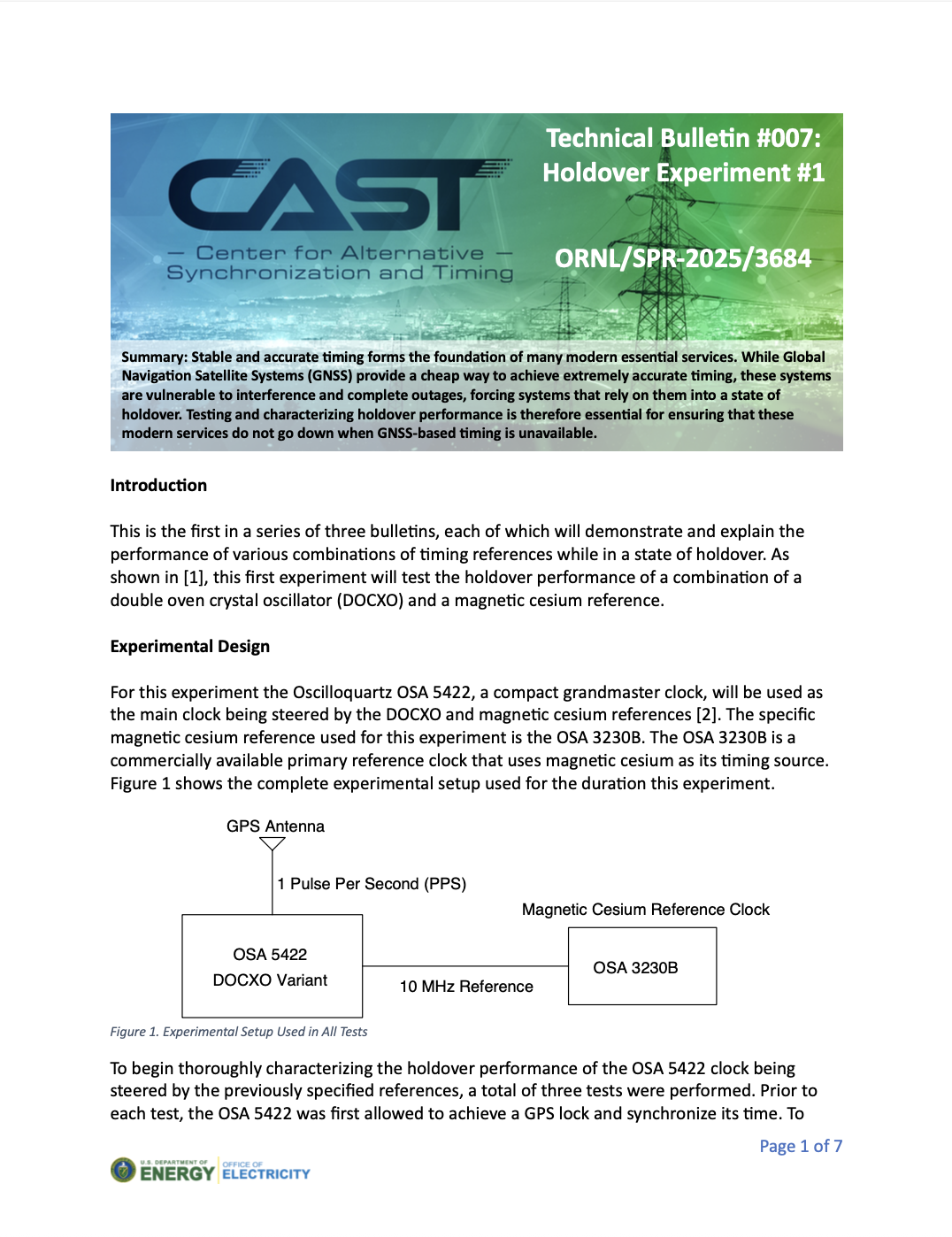
CAST Holdover Experiment #1 - DOCXO and Magnetic Cesium Reference
Stable and accurate timing forms the foundation of many modern essential services.
While global Navigation Satellite Systems (GNSS) provide a cheap way to achieve extremely accurate
timing, these systems are vulnerable to interference and complete outages, forcing systems that rely
on them into a state of holdover. Testing and characterizing holdover performance is therefore
essential for ensuring that these modern services do not go down when GNSS-based timing is unavailable.
March 27, 2025
Timing Holdover Experiments Summary
Stable and accurate timing forms the foundation of many modern essential services.
While Global Navigation Satellite Systems (GNSS) provide a cheap way to achieve extremely accurate
timing, these systems are vulnerable to interference and complete outages, forcing systems that rely
on them into a state of holdover. Testing and characterizing holdover performance is therefore
essential for ensuring that these modern services do not go down when GNSS-based timing is unavailable.
March 27, 2025
NTP Monitoring
Network Time Protocol (NTP) is an established internet protocol that has been widely
used for clock synchronization between computers and time-critical devices over packet-switched networks.
It is a bidirectional protocol that allows network nodes to send timing information in a hierarchical
structure. In the US Department of Energy's national energy delivery mission, NTP has been widely
deployed for keeping the power grid devices in sync for safe and efficient electricity delivery. ORNL's
Center for Alternative Synchronization and Timing (CAST) aims to provide a terrestrial timing
infrastructure alternative for next-generation power delivery by using an effective combination of NTP
with high-precision Precision Time Protocol (PTP). In CAST, whereas PTP carries the bulk of long-distance
terrestrial synchronization transmission, both NTP and PTP can be effective means for enterprise internal
time synchronization subscriptions. This bulletin examines various tools and methods that can be used to
monitor multiple aspects of NTP operation and its performance.
September 20, 2024
Implementing NTP Internally
Network Time Protocol (NTP) is a widely consumed standard for distributing time
across network devices. It is also a legacy system with known security vulnerabilities. The
vulnerabilities can be mitigated through modern implementations of NTP that include internal and
external redundancy, ensure fault tolerance, and reduce cyber threats. While Precision Time Protocol
(PTP) is a preferred approach, this technical bulletin provides recommendations for leveraging NTP
internally when architectures require it or devices are not PTP-enabled.
August 19, 2024
The Role of GPS for Timing System Calibration
This CAST technical bulletin highlights the importance of GPS connectivity for
Remote Timing Units. This bulletin will describe how GPS is currently used in a timing and
synchronization architecture to validate the accuracy of a PTP signal. GPS provides an important
link to an authoritative timing source and enables the calibration and validation of terrestrial
timing systems for meeting power grid accuracy requirements. Absent GPS, a well-calibrated
grandmaster clock will maintain a highly stable PTP timing distribution using a reference atomic
clock, such as a Cesium reference.
June 11, 2024
The Flow of Timing Signals from Clocks to Devices
This CAST technical bulletin gives a description of the updated efforts
on Oak Ride National Lab (ORNL) Center for Alternative Synchronization and Timing (CAST)
project's work investigating a terrestrial-based high precision timing infrastructure
intended for tie synchronization of the next generation power delivery infrastructures.
We will provide a high-level description of the CAST application context, key protocols,
critical architecture issues, and how GPS/timing data traverse through the system.
May 30, 2024
Network Monitoring using PTP
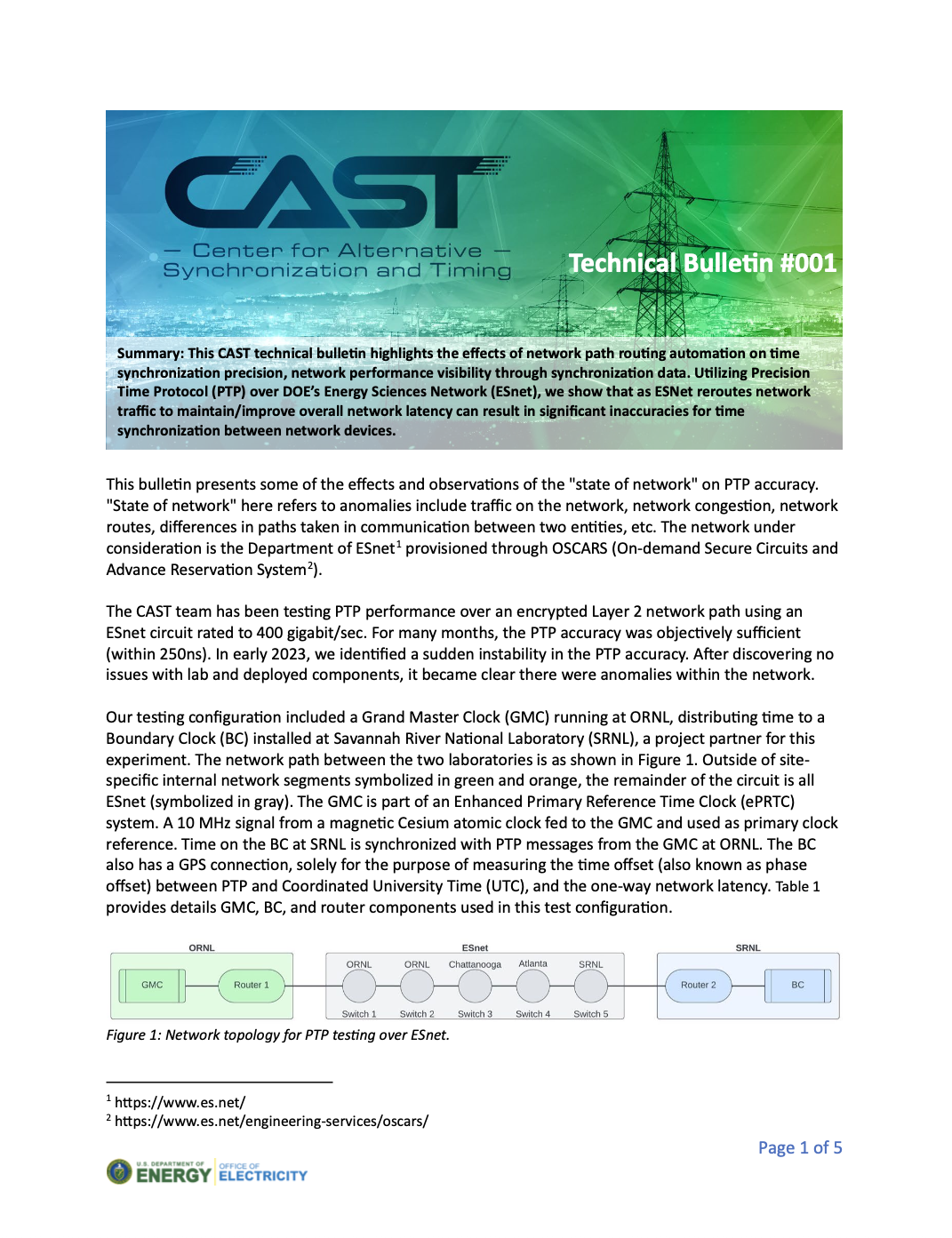
This CAST technical bulletin highlights the effect of network path routing
automation on time synchronization precision, network performance visibility through synchronization data.
Utilizing Precision Time Protocol (PTP) over DOE's Energy Sciences Network (ESNet), we show that as ESNet
reroutes network traffic to maintain/improve overall network latency can result in significant inaccuracies
for time synchronization between network devices.
January 26, 2024